Electric height adjustable desks are increasingly used in corporate offices, home workstations, educational environments, and creative studios. For furniture manufacturers and B2B buyers, choosing the right desk frame involves more than selecting a motor. The lifting column structure, transmission mechanism, frame dimensions, load capacity, and height adjustment range all influence how the desk performs in daily use. Understanding these factors helps buyers select a lifting system that matches their product design, budget, and application requirements.
The position of lifting components can affect desk frame assembly, under-desk clearance, cable routing, and maintenance access. Depending on the design, components mounted closer to the desktop may simplify certain frame connections, while components positioned lower in the frame may provide different options for packaging and installation. However, neither arrangement is inherently more stable or efficient. Actual performance depends on the relationship between the lifting columns, mounting brackets, crossbars, feet, and desktop.
When comparing an upper-mounted and a lower-mounted lifting structure, buyers should first clarify which components are being positioned differently. The mounting location of the motor, the connection between the lifting column and frame, and the direction of telescopic movement are separate design considerations. A well-designed structure should provide sufficient clearance throughout the lifting range, prevent interference between moving components, and allow convenient access to electrical connections and fasteners. For OEM and ODM furniture projects, reviewing assembly drawings and testing the complete frame is more reliable than evaluating mounting position alone.
A single motor electric height adjustable desk uses one motor to drive the lifting mechanism. Depending on the system design, mechanical transmission components distribute the driving force to the lifting columns so that the desktop can move vertically. The motor, transmission system, control unit, and telescopic columns must work together to deliver consistent movement under the intended load.
Compared with a system using two motors, a single-motor configuration can reduce the number of drive units and simplify certain aspects of system integration. This can be attractive for manufacturers developing cost-conscious office desks and compact workstations. Nevertheless, lifting performance cannot be judged by motor count alone. The transmission efficiency, rated load, column design, frame rigidity, and control system all contribute to the final result. Buyers should verify whether the specified load capacity applies to the complete frame and whether the system has been tested under realistic operating conditions.
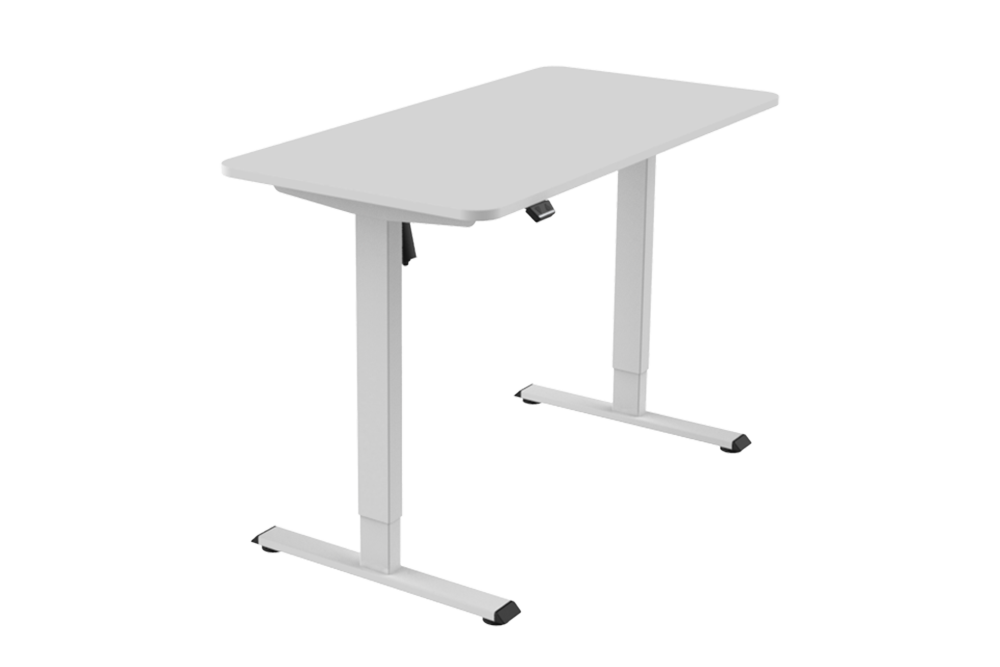
A two-stage telescopic lifting column consists of two main profile sections that slide relative to one another to adjust the desk height. This structure offers a practical balance between lifting range, overall column design, and system complexity. It is particularly relevant to desk projects where the required height adjustment can be achieved without a three-stage column.
Dewert Okin's Electric Height Adjustable Desk Single Motor-2 Stage 6545 illustrates this configuration. The product features a two-part telescopic profile with a 65 × 45 mm outer profile, a minimum height of 695 mm, a maximum height of 1,175 mm, and a 480 mm stroke. These specifications provide a defined operating range for workstation designers. When selecting a two-stage frame, buyers should consider the minimum desk height, maximum working height, user height range, and available space beneath the desktop rather than focusing only on the stroke length.
Load capacity and lifting speed are two important specifications when evaluating an electric height adjustable desk single motor system. The 6545 frame is rated at 800 N, with a maximum lifting speed of 25 mm/s. The new desk configuration should be evaluated against the combined weight of the desktop, monitors, computer equipment, and accessories, while leaving an appropriate operating margin.
It is also important to distinguish between force and mass. Newtons (N) measure force, whereas kilograms (kg) measure mass. An 800 N rating is approximately equivalent to the weight force of 81.6 kg under standard gravity, but this conversion should not be interpreted as a guaranteed usable payload of 81.6 kg in every installation. Buyers should confirm the manufacturer's definition of rated load, including whether the rating covers the complete desk frame and the conditions under which it applies.
A maximum lifting speed of 25 mm/s offers a useful reference for comparing products, but the actual movement time depends on the distance travelled and operating conditions. For example, a 480 mm stroke would take approximately 19.2 seconds at a constant speed of 25 mm/s. This is a theoretical estimate, not a guaranteed cycle time, because acceleration, deceleration, and control settings may affect actual operation. For procurement decisions, it is useful to assess speed alongside noise, movement smoothness, duty cycle, and performance under load.
A stable standing desk depends on the entire mechanical structure rather than the motor alone. The stiffness of the lifting columns, the geometry of the frame, the design of the feet, the quality of the mounting connections, and the distribution of equipment across the desktop can all affect stability. As the desk rises, the increased height may make lateral movement more noticeable, particularly when heavy equipment is positioned near the desktop edges.
For this reason, manufacturers should assess stability at both seated and standing heights. Testing should consider realistic desktop dimensions, representative loads, uneven load distribution, and repeated lifting cycles. Fasteners should be tightened according to the installation instructions, and the desktop should remain within the frame's intended dimensional range. These checks help identify potential movement or interference before the product enters mass production.
Buyers should also distinguish between static load capacity and dynamic lifting performance. A frame that supports a specified load while stationary must still be evaluated for smooth and reliable movement when that load is raised or lowered. The manufacturer's test data and installation requirements are therefore essential when comparing competing products.
The choice between single-motor and dual-motor systems depends on the intended workstation, not simply on which configuration has more motors. A single-motor frame may be suitable for standard office desks and projects where the specified load and adjustment range meet the application requirements. A dual-motor design may be worth considering for larger workstations, heavier equipment, or applications requiring different lifting performance, provided the complete system specifications support those needs.
Dewert Okin's product range includes both single-motor and dual-motor desk frames, giving furniture manufacturers options for different workstation designs. When comparing models, buyers should review rated load, speed, height range, frame width, lifting-column structure, control functions, and installation dimensions together. A higher motor count does not automatically guarantee greater stability, and a single-motor design should not be considered inadequate if it meets the required performance criteria.
The adjustable frame width determines which desktop sizes can be accommodated by a particular desk frame. The Dewert Okin 6545 model has a frame width range of 1,100–1,500 mm, providing flexibility for a range of workstation layouts. However, frame width alone does not establish compatibility with every desktop. Desktop length, depth, thickness, mounting points, and total load distribution should also be checked.
For furniture manufacturers, these details are especially important when developing product families with different desktop materials and dimensions. A frame should be matched to the intended tabletop and mounting arrangement to avoid excessive overhang, unsuitable screw positions, or interference with under-desk accessories. Confirming dimensions before production can reduce assembly problems and improve consistency across batches.
Regular inspection can help maintain the performance of an electric lifting desk. Users and maintenance teams should keep lifting columns free of accumulated dust, inspect accessible fasteners periodically, and check cables for damage or interference with moving components. The desk should be operated within the manufacturer's specified load limits and installed according to the supplied instructions.
If the desk develops unusual noise, uneven movement, or unexpected stopping, continued operation should be avoided until the cause has been checked. Possible factors include loose connections, obstruction, excessive loading, or issues within the electrical or mechanical system. Troubleshooting should follow the manufacturer's guidance rather than relying on unverified adjustments. For B2B suppliers, clear installation instructions and maintenance documentation are valuable parts of a reliable product offering.